People Management
What’s The Difference Between Double Time, Overtime, And Time And A Half? Plus, How To Calculate Overtime Pay

Paying hourly employees sounds simple until overtime, double time, and time and a half start stacking up across different shifts.
A missed rule or miscalculation can lead to payroll errors, compliance issues, or unexpected labor costs.
In this guide, you’ll learn the difference between double time, overtime, and time and a half, how each is calculated, and when they apply. You’ll also see why many businesses rely on workforce management and time tracking tools to keep pay rates accurate as schedules change.
The Fair Labor Standards Act (FLSA) sets the foundation for overtime rules, but state laws can add another layer of complexity. That makes handling timesheets and calculating overtime more difficult than it first appears.
Knowing when to apply overtime pay, time and a half, or double time is essential to getting payroll right, especially for teams working across multiple shifts and roles.
For many businesses, tracking overtime and applying different pay rates manually becomes difficult as schedules change. Tools like When I Work help keep hours, pay rates, and timesheets aligned automatically.
Before getting into calculations, it’s important to understand how overtime is defined. Under the FLSA, a workweek is a series of seven consecutive 24-hour periods. While employers can define when that week starts, it must remain consistent.
The FLSA also does not limit the number of hours employees over 16 can work in a day, which is why overtime rules play a critical role in managing labor costs.
Managing overtime and payroll manually often leads to errors and extra admin. For many teams, that quickly becomes unsustainable:
“The app saves time, money, and a lot of headaches. It pays for itself just in the labor cost of figuring time for payroll.”
– Richard Merritt, Administrator, Randolph Security
Key takeaways
- Double time means paying employees twice their normal rate, but it is not required under the FLSA and typically applies only in specific situations (such as under California law or a union agreement)
- Overtime pay is required for nonexempt employees who work more than 40 hours per week, usually at time-and-a-half
- Time and a half means 1.5× the regular hourly rate for overtime hours
- Managing multiple pay rates across shifts can quickly become complex without accurate time tracking
- Many businesses use workforce management software to calculate overtime and keep payroll accurate
This example shows how regular pay, time and a half, and double time compare across the same hourly rate. As overtime hours increase, labor costs can rise quickly.
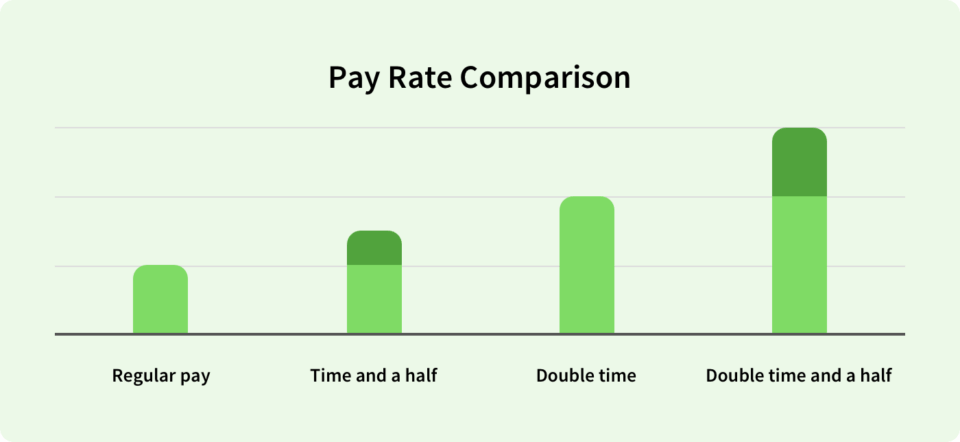
Table of contents
- What is double-time pay?
- What is overtime?
- What is time and a half?
- Common overtime and payroll challenges
- How to manage overtime and labor costs
- Double time vs. overtime FAQs
Overtime, double time, and time and a half are easy to get wrong when schedules change mid-week. See how When I Work helps keep hours, pay rates, and payroll aligned automatically.
Start Your Free Trial Of When I Work Today.
What is double time?
Double time means paying an employee twice their normal hourly rate for hours worked. For example, if an employee earns $15 per hour, double time pay would be $30 per hour.
Unlike overtime pay, double time is not required under the Fair Labor Standards Act (FLSA). Most employers only offer it in specific situations, such as:
- Working on holidays
- Exceeding certain daily or weekly hour thresholds
- Union agreements or company policies
This is where confusion often starts. Double-time rules are inconsistent across states, and in many cases, whether they apply depends entirely on the employer.
For example, California is the only state with formal double-time laws. In most other states, double time is optional unless defined by contract.
How to calculate double time
Double time pay is typically calculated as:
- 2 × regular hourly rate × eligible hours worked
In California, double time applies under specific conditions:
- Hours worked over 12 in a single day
- Hours worked over 8 on the seventh consecutive day in a workweek
Because rules vary by state and employer, manually calculating double time can be difficult, especially when employees work different roles, shifts, or locations in the same pay period.
Managing double time and pay rates
When pay rates vary by hours, roles, or shift types, manually tracking everything increases the risk of payroll errors. Keeping hours, wages, and shift details in the same system helps reduce those mistakes as schedules change.
What is double time and a half?
Double time and a half refers to paying an employee 2.5 times their normal hourly rate. For example, a $20/hour role would earn $50/hour under this rate.
This type of pay is typically used in specific scenarios, such as holidays, extended overtime, or contractual agreements, rather than being required by law.

What is overtime?
Overtime refers to hours worked beyond the standard workweek, typically more than 40 hours. Under the Fair Labor Standards Act (FLSA), nonexempt employees must be paid overtime pay at a higher rate, usually time and a half.
This means an employee earning $20 per hour would earn $30 per hour for overtime hours.
Overtime rules are not always the same everywhere. While the FLSA sets the 40-hour workweek standard, some states, including California, Alaska, and Nevada, also require daily overtime when employees work more than a set number of hours in a single day.
Because of this, employers often need to track both:
- Weekly overtime (over 40 hours)
- Daily overtime (based on state laws)
Overtime also cannot be waived. Even if extra hours were not approved in advance, eligible employees must still be paid the correct overtime rate.
Why overtime becomes difficult to manage
Overtime usually appears in small increments, not in a single obvious jump. A late finish here or an extra shift there can push labor costs higher before anyone notices.
By the time payroll is processed, overtime costs can already be higher than expected.
This is why many businesses focus on tracking overtime in real time rather than calculating it after the fact.
How to calculate overtime
To calculate overtime, start by identifying whether you are working with daily or weekly thresholds:
- Determine the overtime threshold
- 40 hours per week (FLSA standard)
- Or daily limits based on state law
- Add up total hours worked
- Subtract the threshold from the total hours
- Any remaining hours are overtime hours
Overtime pay is typically calculated at 1.5 times an employee’s regular hourly rate, also known as time-and-a-half.
Tracking overtime accurately
As schedules change throughout the week, tracking overtime manually becomes more difficult, especially when employees work different roles or shifts. Real-time visibility into hours worked makes it easier to catch overtime before it turns into a payroll problem.
Double time vs overtime
The difference between double time and overtime comes down to the pay rate.
- Overtime is typically paid at 1.5× the regular hourly rate
- Double time is paid at 2× the regular hourly rate
Overtime is required under federal law for eligible employees, while double time is usually optional and depends on state laws or employer policies.
What is time and a half?
Time and a half means paying an employee 1.5 times their regular hourly rate for overtime hours worked. For example, if an employee earns $20 per hour, their time-and-a-half rate would be $30 per hour. This is commonly referred to as paid time and a half and is the most widely used form of overtime pay.
When budgeting for peak seasons or extended shifts, many managers ask how much time-and-a-half would be for their specific team. To find the answer, you simply take the base hourly wage and increase it by 50%.
Time and a half is the most common form of overtime pay and is required under the Fair Labor Standards Act (FLSA) for eligible employees who work more than 40 hours in a workweek.
When time and a half applies
Time and a half typically applies when employees work beyond their regular schedule, such as:
- Working more than 40 hours a week
- Exceeding daily hour limits in certain states
- Covering additional shifts or staying late during busy periods
Because overtime hours can accumulate quickly across multiple shifts, it’s important for managers to understand when time-and-a-half applies and how it affects labor costs.
How to calculate time and a half
To calculate time and a half:
- Identify overtime hours worked
- Multiply the regular hourly rate by 1.5
- Multiply the overtime hours by the new rate
Example:
- Regular rate: $20/hour
- Overtime rate: $30/hour
- 5 overtime hours = $150 overtime pay
This calculation applies to any situation in which employees qualify for time-and-a-half overtime, whether under weekly or daily overtime rules.
Overtime vs time and a half
The difference between overtime and time and a half is simple:
- Overtime refers to the extra hours worked beyond a standard schedule
- Time and a half is the pay rate applied to those overtime hours
Managing time and a half pay
As schedules change throughout the week, tracking overtime hours and applying the correct time-and-a-half rate can become difficult, especially for teams working different roles or shifts.
Keeping track of overtime hours and pay rates manually becomes harder as shifts change, which is why many teams move to automated overtime tracking.
Common challenges when calculating overtime and time and a half
Overtime calculations become more complex when schedules, roles, and hours don’t align cleanly. Small differences in time worked or pay rates can lead to errors that only show up at payroll.
By the time payroll is processed, small discrepancies can turn into bigger issues that take time to correct.
Tracking hours across changing shifts
Schedules change constantly in hospitality and other shift-based teams. Employees swap shifts, cover for callouts, or work longer than planned during busy periods.
Keeping an accurate record of hours worked becomes difficult when those changes aren’t tracked in real time, especially across multiple employees and locations.
Managing multiple pay rates
Overtime is not always calculated at a single rate. Employees may work different roles, earn different hourly wages, or qualify for different pay rates within the same pay period.
Tracking those changes manually increases the risk of applying the wrong rate or missing overtime altogether.
Understanding state and federal overtime rules
Overtime rules vary depending on where your business operates. While the FLSA sets a 40-hour weekly threshold, some states also require daily overtime based on hours worked in a single day.
Without a clear system, it becomes difficult to apply the correct rules consistently across employees.
Classifying employees correctly
Not all employees are treated the same under overtime laws. Misclassifying exempt and nonexempt workers can lead to unpaid overtime or compliance issues.
These mistakes often aren’t caught until payroll is reviewed, which can result in back pay or penalties.
Keeping overtime and payroll aligned
When hours, pay rates, and employee schedules are tracked separately, payroll becomes harder to manage. Errors are more likely when information has to be pulled together from multiple sources at the end of the week.
Keeping overtime calculations accurate is much easier when hours and pay rates are tracked in the same system, rather than pulled together manually at the end of the week.
Smarter labor cost control with When I Work
Overtime, double time, and time and a half don’t exist in isolation. They show up across real schedules, when shifts run long, roles change, or coverage needs shift during the week.
That’s where payroll issues usually start. Hours and pay rates need to line up exactly, but when they’re tracked separately or updated manually, mistakes are easy to miss until payroll is already in progress.
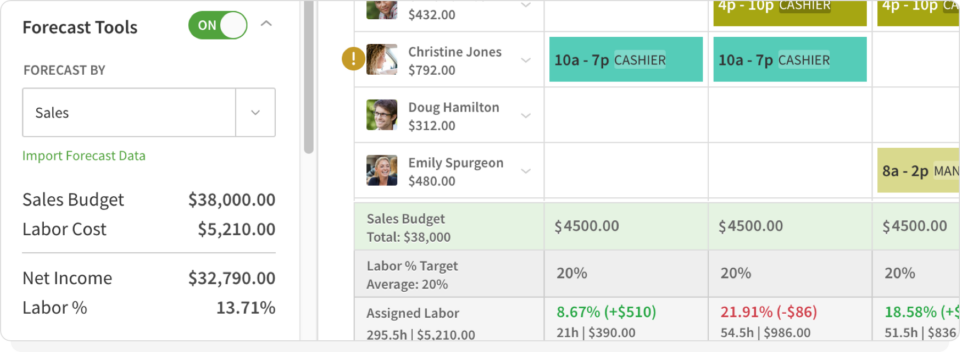
When I Work keeps employee scheduling, time tracking, and pay rates together. As hours are worked, overtime is automatically tracked and applied at the correct rate, so managers can see how labor is building up before the pay period ends.
That visibility makes it easier to adjust schedules, reduce unnecessary overtime, and keep payroll accurate without extra admin. Instead of correcting errors after the fact, teams can manage labor costs as they happen.
To see how this works in practice, start a free trial of When I Work and explore how to keep overtime calculations and payroll aligned as schedules change.
Double time, overtime, and time and a half FAQs
Managing overtime pay, time and a half, and double time can raise a lot of questions, especially for businesses with shift-based teams. Below are answers to common questions about overtime rules, pay calculations, and how these rates apply in real-world situations.
What is the main difference between double time and overtime?
The main difference between double time and overtime is the pay rate applied to extra hours worked.
- Overtime pay is typically 1.5 times an employee’s regular hourly rate (time-and-a-half) for hours worked beyond the standard workweek
- Double time is 2 times the regular hourly rate and is usually offered in specific situations, such as holidays, extended shifts, or under certain state laws or agreements
Overtime is required under federal law for eligible employees, while double time is generally optional and depends on employer policy or local regulations.
Is double time covered by the Fair Labor Standards Act (FLSA)?
No, the Fair Labor Standards Act (FLSA) does not require employers to pay double time. The FLSA only mandates overtime pay, typically at time and a half (1.5× the regular hourly rate), for eligible employees who work more than 40 hours in a workweek.
Double-time pay is usually optional and depends on state laws, union agreements, or employer policies. For example, California has specific rules that require double time in certain situations, such as when daily hours are extended.
When might an employer offer double time pay?
Employers typically offer double-time pay in situations where coverage is harder to fill or when extended hours put additional strain on the team.
This often includes federal holidays, last-minute shift coverage, or situations where employees work significantly beyond their normal schedule, such as very long shifts or consecutive overtime hours. In some industries like hospitality, healthcare, and retail, double time may be used to encourage staff to take on unpopular shifts or peak demand periods.
In other cases, double-time pay is defined by state laws, union agreements, or company policies, rather than federal overtime requirements.
How is overtime defined by the FLSA?
Under the Fair Labor Standards Act (FLSA), overtime pay is required for nonexempt employees who work more than 40 hours in a single workweek. These hours must be paid at a rate of at least 1.5 times the employee’s regular hourly wage.
While this federal rule sets the baseline, some states apply additional overtime laws. For example, California requires overtime pay for any hours worked beyond eight in a day, even if the employee has not exceeded 40 hours in a week.
What does “time and a half” mean in the context of overtime?
“Time and a half” refers to overtime pay at 1.5 times an employee’s regular hourly rate. In simple terms, it means a 50% increase in pay for every hour worked beyond the standard workweek. For example, if an employee earns $10 per hour, their time-and-a-half rate would be $15 per hour.
Once employees cross the 40-hour threshold, labor costs can rise faster than expected. For teams in shift-based workplaces like manufacturing, construction, or field services, extended shifts or project overruns can push hours into overtime faster than expected, increasing total labor costs if schedules are not carefully managed.
Can employees waive their right to overtime pay?
No, under the Fair Labor Standards Act (FLSA), employees cannot waive their right to overtime pay. If a nonexempt employee works eligible overtime hours, those hours must be paid at the appropriate rate, regardless of any prior agreement or circumstance.
This applies even when overtime was not approved in advance or occurred due to scheduling errors. While employers can address policy violations separately, they are still legally required to compensate employees for all overtime hours worked.
In practice, this means managers need clear visibility into hours worked and should address overtime proactively, rather than trying to correct it after the fact.
How can employers manage and calculate these pay structures efficiently?
Employers can manage overtime pay, double time, and time-and-a-half more efficiently by using workforce management tools that automate time tracking and wage calculations. Automation reduces manual errors, supports compliance with labor laws, and gives managers a clear view of how labor costs are building across the week.
With tools like When I Work, managers can track hours in real time, flag potential overtime before schedules are finalized, and apply the correct pay rates automatically across different roles or shifts. The result is better control over scheduling decisions, more accurate payroll, and fewer surprises when labor costs are reviewed.
Article Sources
1. US Department of Labor. Wages and the Fair Labor Standards Act. Accessed March 19th, 2026
2. US Department of Labor. Handy Reference Guide to the Fair Labor Standards Act. Accessed March 19th, 2026
3. California Department of Industrial Relations. Overtime. Accessed March 19th, 2026